
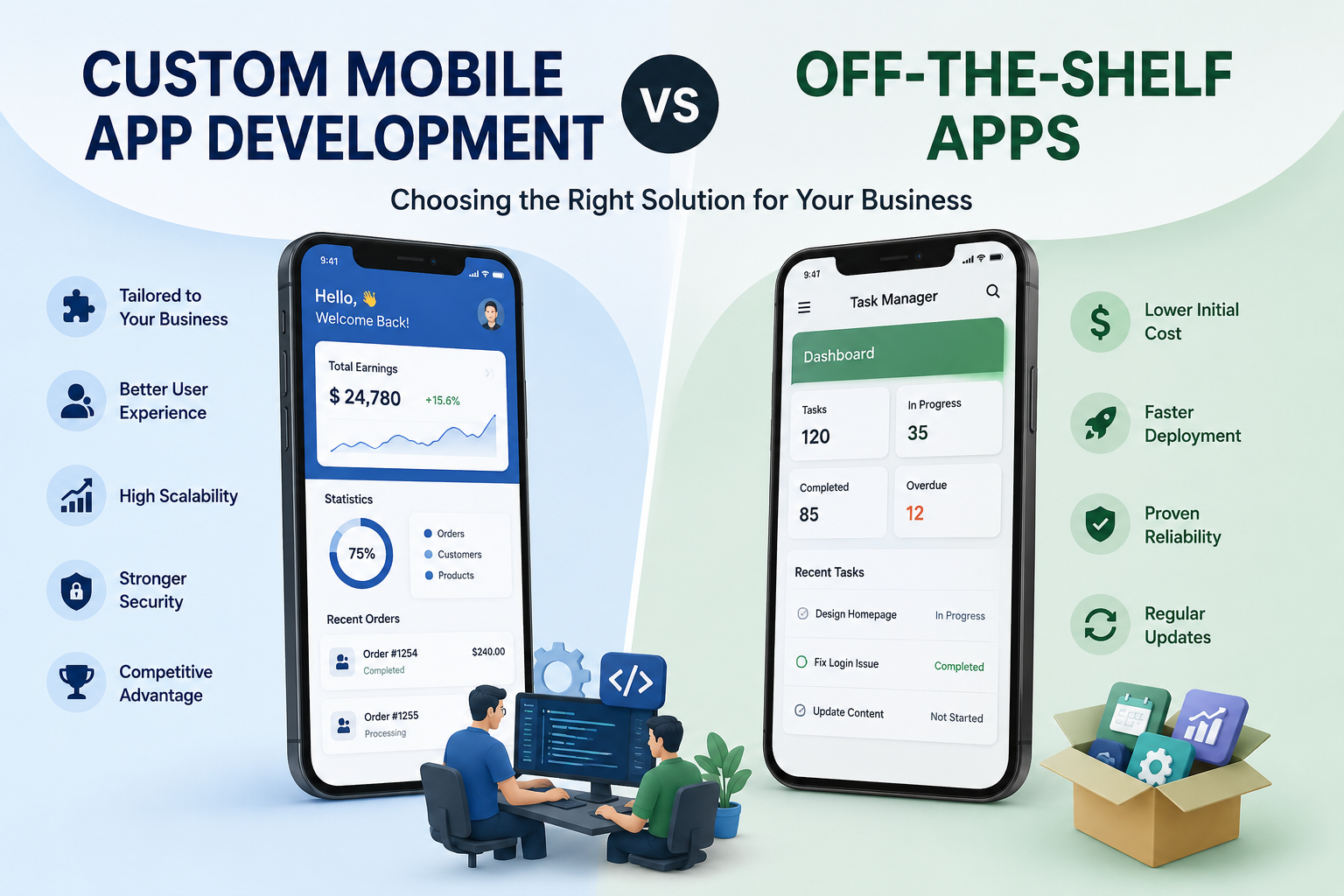
In today’s digital world, having a mobile app can help businesses connect with customers, improve operations, and increase revenue. However, one of the biggest decisions companies face is whether to invest in custom mobile app development or choose an off-the-shelf app.
Both options have their advantages and disadvantages. The right choice depends on your business goals, budget, and long-term plans. In this guide, we’ll explain the key differences between custom mobile apps and ready-made solutions to help you make the best decision.
What Is a Custom Mobile App?
A custom mobile app is designed and built specifically for your business. Instead of using a standard solution, developers create features, design, and functionality based on your unique requirements.
Whether you need an e-commerce platform, healthcare application, logistics solution, or customer service app, a custom application is developed to meet your exact business needs.
Benefits of Custom Mobile Apps
Tailored to Your Business
Every feature is designed around your workflows, customers, and objectives. You only pay for the functionality your business actually needs.
Better User Experience
Custom apps provide a smoother and more personalized experience. A unique design helps strengthen your brand identity while improving customer satisfaction.
High Scalability
As your business grows, your application can easily expand with new features, integrations, and improvements without major limitations.
Stronger Security
Custom mobile applications often include advanced security measures such as encrypted data storage, secure authentication, and compliance with industry standards.
Competitive Advantage
A unique application allows your business to offer features that competitors may not have, helping you stand out in the market.
What Are Off-the-Shelf Apps?
Off-the-shelf apps are pre-built software solutions created for a broad audience. Businesses purchase or subscribe to these applications and start using them with minimal setup.
Examples include appointment booking apps, CRM platforms, inventory management software, and communication tools.
Benefits of Off-the-Shelf Apps
Lower Initial Cost
Since the application already exists, businesses pay a one-time fee or monthly subscription instead of funding an entire development project.
Faster Deployment
Most off-the-shelf apps can be installed and configured within hours or days, making them ideal for businesses that need a quick solution.
Proven Reliability
Popular software has already been tested by thousands of users, reducing the risk of major technical issues.
Regular Updates
Software providers usually release security patches, bug fixes, and new features automatically.
Limitations of Off-the-Shelf Apps
Although ready-made apps are convenient, they often come with restrictions.
Limited Customization
You may not be able to modify important features or workflows to fit your business processes.
Subscription Costs
Monthly or annual subscription fees can become expensive over time, especially for growing businesses.
Shared Features
Because the same software is used by many companies, it becomes difficult to differentiate your business from competitors.
Integration Challenges
Some ready-made apps do not integrate smoothly with your existing software or business systems.
Custom Mobile App vs Off-the-Shelf Apps
| Feature | Custom Mobile App | Off-the-Shelf App |
|---|---|---|
| Development Time | Longer | Immediate |
| Initial Cost | Higher | Lower |
| Customization | Unlimited | Limited |
| Scalability | Excellent | Moderate |
| Security | High | Standard |
| Ownership | Full ownership | Licensed software |
| Competitive Advantage | Strong | Limited |
| Maintenance | Your development team | Software provider |
Which Option Is More Cost-Effective?
Many businesses initially choose off-the-shelf software because of the lower upfront investment. However, long-term costs may increase due to:
- Monthly subscription fees
- Additional user licences
- Premium feature charges
- Integration costs
- Upgrade expenses
Custom mobile app development requires a larger initial investment but often provides better long-term value because you own the application and control future development.
When Should You Choose a Custom Mobile App?
Custom development is ideal if your business:
- Has unique business processes
- Needs advanced integrations
- Plans to scale significantly
- Requires high-level security
- Wants complete control over features
- Needs a unique customer experience
Working with an experienced development partner like Sartim Solutions ensures your app is built around your business goals, integrates with your existing systems, and can scale as your company grows.
When Is an Off-the-Shelf App the Better Choice?
A ready-made solution works well if your business:
- Has a limited budget
- Needs an application quickly
- Requires standard features only
- Is testing a new business idea
- Does not require extensive customization
Small businesses and startups often begin with off-the-shelf software before investing in a custom solution.
Factors to Consider Before Making Your Decision
Before choosing either option, ask yourself these questions:
- What problem will the app solve?
- How many users will use the application?
- Will the business grow significantly over the next few years?
- Do you need custom workflows?
- Is customer experience a priority?
- What is your long-term technology budget?
Answering these questions can help you select the most suitable solution.
Can You Start with an Off-the-Shelf App and Upgrade Later?
Yes. Many businesses begin with a ready-made application to validate their ideas and understand customer needs. Once the business grows and limitations become apparent, they transition to a custom-built mobile app that offers greater flexibility and scalability.
This approach reduces initial risk while preparing for future expansion.
The Future of Mobile App Development
Modern mobile applications are becoming more intelligent through technologies such as Artificial Intelligence (AI), machine learning, cloud computing, and the Internet of Things (IoT). Businesses investing in custom app development can adopt these technologies more easily and create innovative customer experiences.
As customer expectations continue to evolve, businesses that use flexible, scalable mobile applications will be better positioned for long-term success.
Conclusion
Both custom mobile app development and off-the-shelf apps have their place in today’s business environment.
If you need a quick, affordable solution with standard features, an off-the-shelf app may be the right choice. However, if your business requires flexibility, scalability, enhanced security, and a unique customer experience, investing in a custom mobile app is often the smarter long-term decision.
Carefully evaluate your business goals, budget, and future growth plans before making your decision. Choosing the right mobile app solution today can support your business growth and provide lasting value for years to come.